
Schema Markup Explained: Why Structured Data Matters for SEO – Navyug InfoTech
Two websites can have identical content, yet one shows up in Google with star ratings, FAQ dropdowns, or product prices, while the other shows a plain blue link.
By Navyug InfoTech, Ahmedabad
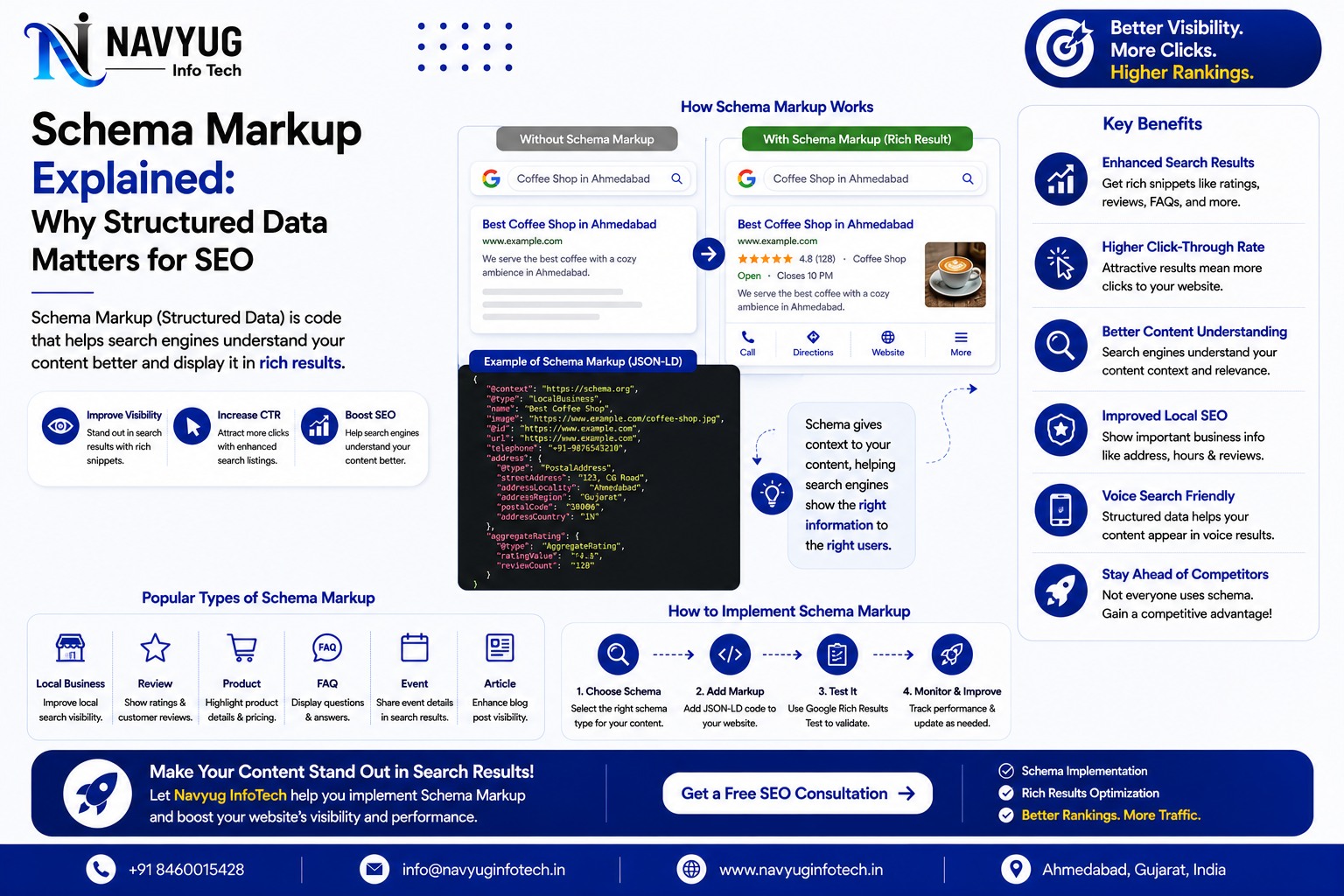
Two websites can have identical content, yet one shows up in Google with star ratings, FAQ dropdowns, or product prices, while the other shows a plain blue link. The difference is usually schema markup for SEO, a layer of code most visitors never see but search engines rely on heavily.
At Navyug InfoTech, we treat structured data as a standard part of technical SEO, not an optional extra bolted on later.
Here’s what it actually is, and why it’s worth caring about.
What Schema Markup Actually Does
- Describes your content to search engines in a structured, machine-readable format
- Helps Google understand what a page is about, not just what it says
- Can unlock enhanced search results like FAQ dropdowns, star ratings, and pricing
- Supports voice search and AI-based search tools that rely on structured data
- Doesn’t directly boost rankings, but improves how your listing looks and performs
Common Types of Schema Worth Using
Organization Schema
Tells search engines who you are: your business name, logo, contact details, and social profiles, forming the foundation of your online identity.
FAQ Schema
Marks up question-and-answer content so it can appear as an expandable FAQ section directly in search results, taking up more visual space.
Product & Offer Schema
Lets eCommerce listings show price, availability, and reviews right in the search result, before a visitor even clicks through.
Local Business Schema
Reinforces your address, hours, and service area, supporting local search visibility alongside your Google Business Profile.
Article & Breadcrumb Schema
Helps blog content and site navigation display more clearly in search results, improving both visibility and click-through rate.
Mistakes We See Often
- Marking up content that isn’t actually visible on the page
- Using the wrong schema type for the content, which Google can penalize
- Duplicate or conflicting schema output from multiple plugins
- Never testing markup, so errors go unnoticed for months
- Treating structured data as a one-time task instead of an ongoing part of SEO
Our Technical SEO Services
Navyug InfoTech implements and audits structured data as part of a complete technical SEO approach, not as an isolated checkbox.
- Schema Markup Implementation & Auditing
- Technical SEO Audits
- Core Web Vitals & Site Structure Optimization
- Rich Result Testing & Error Resolution
- Ongoing Technical SEO Monitoring
Why Choose Navyug InfoTech?
- 10+ Years of Website Development & SEO Experience
- Hands-On Technical SEO, Not Just Content Advice
- We Build Sites and Optimize Them, Reducing Coordination Gaps
- Transparent Reporting on What Was Implemented and Why
- Ongoing SEO Partnership, Not a One-Time Fix
Frequently Asked Questions
Does adding schema markup guarantee rich results in Google?
No. Schema makes your content eligible for enhanced results, but Google decides whether and when to actually display them.
Will schema markup directly improve my rankings?
Not directly, but the improved visibility and click-through rate it can bring often lead to better overall search performance.
Can I add schema markup myself using a plugin?
Basic markup can be added with plugins, but it’s easy to create errors or conflicting data without technical review, which is where a proper audit helps.
Want to Know If Your Website Is Missing Structured Data?
Let Navyug InfoTech run a technical SEO audit and show you exactly what’s missing.
Get Free Consultation


Ready for a website that feels like the future?
Tell us about your business. We will reply with a clear plan, timeline and quote.